The Agent Chakra Manifesto
Why I built an operating system around my judgment, my work and the freedom to decide what comes next.
In this manifesto
I did not set out to build an AI product. I wanted to stop being the bottleneck in my own company.
Sales, content, engineering, operations and strategy all competed for the same thread of attention: mine. I could do useful work in each of them, but I could not carry every conversation, decision and next step in my head at once. Too much of the job was keeping the other jobs connected.
Agent Chakra grew out of trying to change that. I wanted a team that could carry my judgment into the work, use the tools around it and keep moving without needing me to relay every message. I also wanted to run it from my phone, wherever I happened to be.
Duplicate your judgment, not your hours
My bottleneck was not a shortage of things I could learn to do. It was how much I could hold in mind and how many roles I could fill at once.
The idea behind Agent Chakra is to make the knowledge that normally stays inside one person useful to a whole team of agents. Your memories, principles, preferences and ways of working become part of the system. Different roles can draw on what matters to their work without becoming six copies of the same chatbot.
That changes what delegation can mean for a small business. A Content Manager can use the reasons behind a positioning decision. A Business Developer can pick up the customer's actual concern. An Engineering Agent can turn a plain-language request into a change you can try. You keep deciding what matters, without having to personally perform every step.
Duplicate your judgment, not your hours: one person, every role, run from anywhere.
From a conversation to a working company
I started with chat, as most people did. A good conversation could help me think, write or solve a problem. But the understanding often stayed in that conversation. I still had to move the result into another tool, keep the source material in sync and explain the background again when the next job began.
Terminal-based agents came next. They could sustain difficult engineering work and change real software. They also made the operating problem more obvious: I did not want to become the infrastructure team for all the tools that were supposed to help me.
So I gave the project a different brief. The agents had to run in the cloud, keep their work organized and let me direct them from my phone. The system needed memory, methods, connections, recovery and a way to see what had actually happened. Installing a capable agent was only the beginning.
That distinction also runs through my automation work at King of Automation. Useful software connects a process to the next action. Agent Chakra brings that ambition into an ongoing team: an organization around the intelligence, not another place to collect answers.
Seven chakras, one system
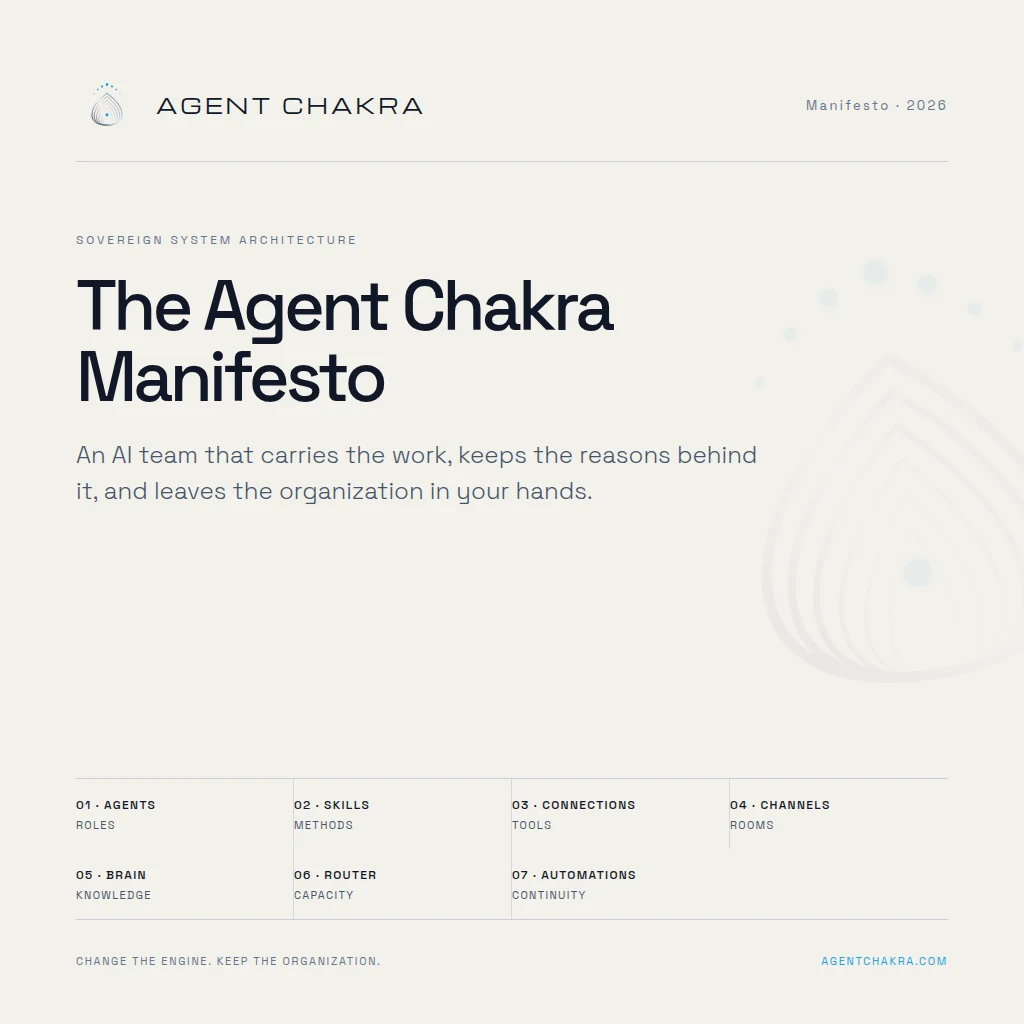
The name expresses how I think about the architecture. The seven chakras are Agents, Skills, Connections, Channels, Brain, Router and Automations. Their value comes from working together.
Agents carry responsibilities. Skills give them methods. Connections let them work in your apps and on websites. Channels put the people and conversations around the work in familiar places. The Brain keeps sourced knowledge and the relationships behind it. The Router puts model capacity to use. Automations start the work that should not need another prompt.
A meeting makes the relationship concrete. Its transcript can become a decision in the Brain, customer language for a campaign, a sales follow-up and an issue for Engineering. Those are different jobs drawing on the same event. The meeting is not valuable because we have another recording. It is valuable because the right next things happen.
The seven components are the skeleton. The credential vault, cloud workspace, file handling, execution records and other supporting systems make them practical to use. They should not become another collection of services the owner has to assemble and maintain.
Keep the reasons, not just the answers
Some of the most valuable information in a business is easy to lose: why you chose one direction over another, what a customer meant, what you corrected last time, or which detail makes a piece of work feel like yours.
The Brain connects conversations, meetings and documents to people, projects and decisions. Background processing organizes that material and extracts relationships. A later task can recover the source behind a conclusion instead of relying on a memory nobody can inspect.
Methods matter just as much. A procedure you trust is more useful than a prompt you keep rewriting. The team starts with task-specific methods and quality checks. You can add your own playbooks and standing instructions while keeping them distinct from the library the platform maintains.
Work should leave the organization more capable than it was before. That does not mean collecting everything indiscriminately. It means keeping the right knowledge, making corrections usable and preserving the boundaries between your business and personal life.
Authority without constant supervision
I want agents that can act, not assistants that return every small decision to me. I also want to know what they did and why.
That calls for authority I can shape. Some work belongs in a draft-and-review process. Other work should run automatically under the settings I choose. A content routine, for example, can prepare drafts for review or publish under an authorized policy.
The conversation is an operating floor, not a black box. Handoffs, sources, returned files and execution details make the work inspectable. When something needs my judgment, I want the relevant question, not a page of technical commentary or an endless stream of identical alerts.
Feedback should improve the system too. I want to correct a method and see that correction matter in later work, rather than repeat myself in every new conversation. Changes to the foundations still need deliberate review. Improvement is useful when it preserves the things I have made mine.
Change the engine. Keep the organization.
The models underneath will keep changing. Their prices, capabilities and availability will change with them. My company should not have to start again each time.
That is why roles, methods, knowledge and configuration are separate from the providers handling individual requests. The Router brings available accounts and model capacity together. Different work can follow different priorities and budgets, with alternatives when a route is limited.
The same principle applies to leaving. The data, methods and configuration that make the system valuable should remain yours to export. I want people to stay because the organization they are building keeps becoming more useful, not because moving away would mean losing it.
A business should give something back
I am interested in what this capacity lets a person do. It may let an existing business owner support their team without micromanaging every handoff. It may let someone with an idea direct engineering, content and sales work they could not previously carry through alone.
It should also leave room for life. Personal assistance belongs in its own space: plans, appointments, travel and everyday matters, with personal knowledge kept separate from the business.
I write more about the life behind these choices in The Sovereign Minimalist. Ambition and freedom are not opposites for me. I enjoy building difficult things. I want the systems I build to make that choice easier, rather than demand all my attention simply to keep them alive.
Agent Chakra is the practical expression of that belief. I built it around my own company. The beta is where we shape it around other people's work, starting with something useful they can actually hand over.
The standard is simple: more capacity to do work that matters, more ownership of what you learn, and more say over the rest of your day.